This Niceday Steppers for Exercise review looks at a compact hydraulic stepper designed for short home cardio sessions, with resistance bands and a simple LCD monitor.
Its small footprint and adjustable stride may suit people who want a movable workout station without dedicating space to a larger machine.
Niceday Stepper Review Summary
The quick verdict
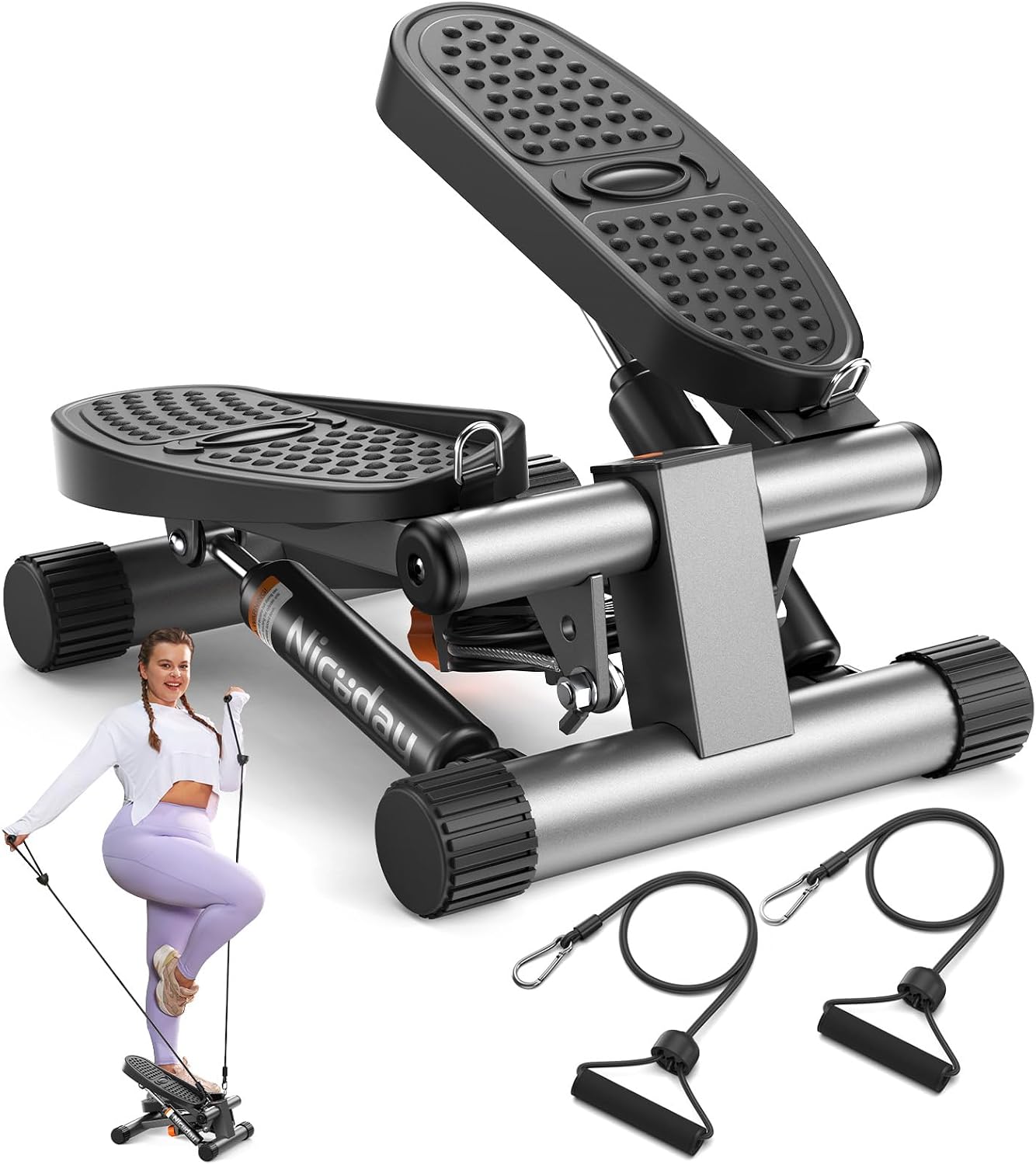
Niceday Mini Stepper
A compact option for home exercisers who want adjustable stepping, resistance bands, and basic workout tracking in a small footprint.
- Compact dimensions of 16 by 12 by 14 inches, with a stated footprint of 1.29 square feet.
- 16-pound weight for moving between rooms or storing after a workout.
- Hydraulic system described as maintaining high resistance for 30 minutes per exercise cycle, then gradually decreasing.
- Stride adjustment knob changes step height, allowing a lower or higher stepping motion.

Pros
- Small footprint and light weight make it practical for homes with limited workout space.
- Stride-height adjustment provides a simple way to tailor the stepping motion.
Consider before buying
- The resistance cycle is described as changing after 30 minutes, so buyers seeking a consistent resistance feel throughout longer sessions should confirm that this pattern suits them.
- The listed monitor data are basic; buyers who want more detailed workout tracking should check whether its measures meet their needs.
Read the full review summary
The Niceday Mini Stepper combines a stepping platform with two resistance bands, a stride adjustment knob, and a monitor that tracks count, time, calories, and repetitions per minute.
It is intended to be ready to use out of the box, weighs 16 pounds, and measures 16 by 12 by 14 inches, making it easier to move and tuck away than larger cardio equipment.
Its most relevant advantage is the combination of compact storage and several ways to vary a session: adjust the stride height, step at a comfortable pace, or add band movements for the upper body.
The hydraulic resistance is described as remaining high for 30 minutes in each cycle and then gradually decreasing.
Buyers should consider whether that resistance pattern and a low stepper’s movement are appropriate for their routine, and check the operating setup and weight limit against their needs.
The buying factors
Niceday Stepper Scorecard
Editorial scores reflect listed features and buyer fit; they are not laboratory measurements or customer ratings.
Space efficiency
The compact 16 by 12 inch footprint and 16-pound weight favor moving and storing it between sessions.
Workout versatility
Stride adjustment and included resistance bands allow some variation across stepping and upper-body movements.
Workout feedback
The LCD tracks several basic session measures, though the listed data points are limited to count, time, calories, scan, and repetitions per minute.
Resistance flexibility
A stride adjustment offers a way to change step height, while the hydraulic resistance follows a described cycle rather than an explicitly user-adjustable tension setting.
Portability
At 16 pounds, the stepper is designed to be easy to move around a home.
Capacity information
A 300-pound loading capacity is specified, giving buyers a clear limit to compare with their requirements.
Key Features and Specifications of Niceday Stepper
- Compact dimensions of 16 by 12 by 14 inches, with a stated footprint of 1.29 square feet.
- 16-pound weight for moving between rooms or storing after a workout.
- Hydraulic system described as maintaining high resistance for 30 minutes per exercise cycle, then gradually decreasing.
- Stride adjustment knob changes step height, allowing a lower or higher stepping motion.
- Two resistance bands are included for adding upper-body movements while stepping.
- LCD monitor tracks count, time, calories, scan, and repetitions per minute.
- Specified loading capacity of 300 pounds and two-year service assurance.
Pros and Cons of Niceday Stepper
Pros
- Small footprint and light weight make it practical for homes with limited workout space.
- Stride-height adjustment provides a simple way to tailor the stepping motion.
- Resistance bands support upper-body movements alongside stepping.
- The monitor provides several basic measures for tracking session progress.
Consider before buying
- The resistance cycle is described as changing after 30 minutes, so buyers seeking a consistent resistance feel throughout longer sessions should confirm that this pattern suits them.
- The listed monitor data are basic; buyers who want more detailed workout tracking should check whether its measures meet their needs.
- The 300-pound loading capacity is a firm fit consideration, so buyers should compare it with their requirements before choosing.
Who Should Buy Niceday Stepper?
Good fit
Consider the Niceday Mini Stepper if you want a compact stepping machine that can be moved between rooms and stored in a tight corner.
The adjustable stride and resistance bands add options for changing how you use a short home workout.
It may also suit people who appreciate a simple display for time, count, and pace.
Before buying, compare the 300-pound capacity with your needs and consider whether a hydraulic resistance cycle that gradually decreases after 30 minutes aligns with your typical session length.
Who should skip it
Look elsewhere if your routine depends on a larger cardio machine, a fixed resistance feel during sessions longer than 30 minutes, or workout data beyond the monitor’s listed measures.
The compact format is most useful when small storage and easy movement matter.
How the Niceday Stepper Fits a Home Routine
Small footprint, simpler setup
At 16 by 12 inches across, the stepper is designed to occupy little floor space, and its 16-pound weight can make it easier to move when a room needs to be cleared.
It is described as ready to use out of the box, a useful detail for buyers who prefer to avoid assembly, though it still makes sense to choose a stable, clear exercise spot before starting.
Adjusting stride and pacing
The knob changes step height, with a lower stride described as easier for extending a session and a higher stride intended for a more demanding motion.
That gives the user one straightforward adjustment, but the description does not specify a separate manual tension control; check that the available stride adjustment is enough for the way you want to vary workouts.
Hydraulic resistance and session length
The hydraulic system is described as providing high resistance for 30 minutes per cycle, with resistance gradually decreasing afterward.
This design detail matters to anyone planning longer continuous workouts: the feel may change over time, so consider how that fits your usual pacing rather than assuming the resistance remains constant.
Bands and basic feedback
The two included resistance bands add an option for arm and upper-body movements while stepping, although buyers should decide whether they prefer to coordinate those movements with their footwork.
The LCD covers count, time, calories, scan, and repetitions per minute, which may be enough for simple session awareness but is a limited set for people who want more detailed workout records.
Alternatives to Niceday Stepper
No alternative model is recommended here. Compare the design and features that matter to your routine before choosing another option.
Is Niceday Stepper Worth It?
The Niceday Mini Stepper is worth considering for a home exerciser who values compact storage, easy movement, adjustable step height, and optional band work.
Its listed tracking is straightforward, and the 300-pound capacity gives a concrete fit limit to check.
The key tradeoff is the hydraulic resistance pattern, which is described as gradually decreasing after 30 minutes.
If that suits your session length and the compact stepper format matches your routine, it offers a practical way to add stepping at home; buyers needing longer steady resistance or more detailed tracking should compare other designs.
Your review at a glance
Niceday Mini Stepper
A compact option for home exercisers who want adjustable stepping, resistance bands, and basic workout tracking in a small footprint.
- Compact dimensions of 16 by 12 by 14 inches, with a stated footprint of 1.29 square feet.
- 16-pound weight for moving between rooms or storing after a workout.
- Hydraulic system described as maintaining high resistance for 30 minutes per exercise cycle, then gradually decreasing.
- Stride adjustment knob changes step height, allowing a lower or higher stepping motion.